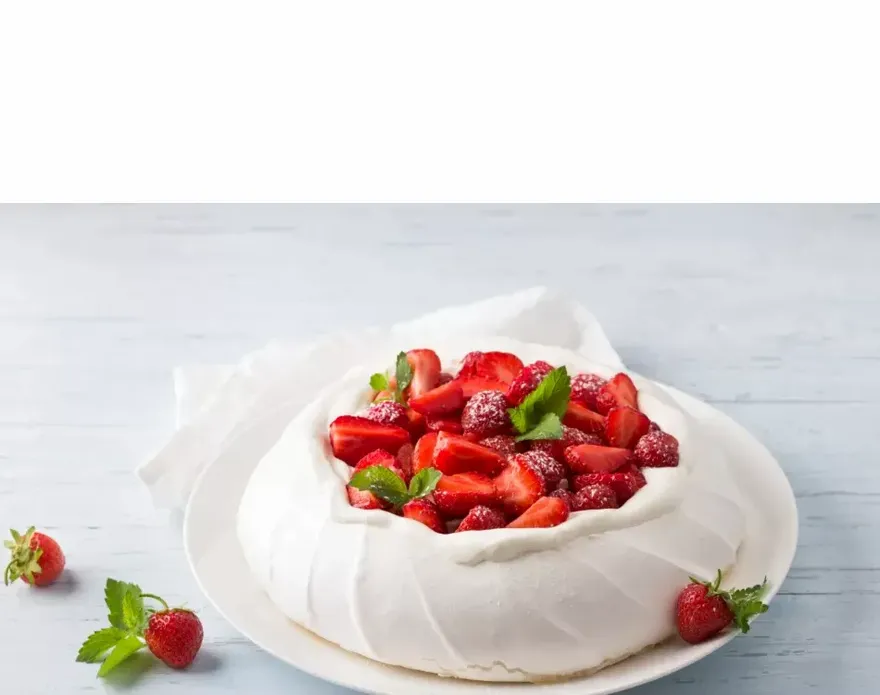
Pencuci mulut klasik Pavlova ringan, lapang, seperti rok ballerina, meringue dengan kerak renyah tipis dan souffle lembut lembut, dilengkapi dengan krim dan strawberi. Salah satu pencuci mulut yang paling digemari oleh keluarga kami.
- Am \ aset masa memasak: 3 jam \ 30 minit
- Hidangan Setiap Bekas: 8 Porsi
- Kalori (100g): 173 kkal
- Kos: sangat menjimatkan
Cara membuat kek meringue Pavlov
- Telur ayam - 4 biji. hanya protein
- Gula tepung - 220 g
- Kanji - 1 sudu kecil
- Jus lemon - 2 sudu kecil
- Krim - 200 ml dari 33%
- Stroberi - 200 g
- Pudina - 1 tangkai daun untuk hiasan
Soalan dan Jawapan (FAQ)
What is the difference between a meringue and a pavlova?
Both meringue and pavlova are egg white desserts , and are made in a similar way. … However, meringue is crispy and dry throughout, while pavlova is crispy on the outside, but fluffy, soft and marshmallow-like on the inside. So a pavlova is a meringue based dessert, but not a classic meringue.
What type of meringue is used for pavlova?
Almost every pavlova recipe starts with a French meringue , which is made by whipping raw egg whites and sugar to stiff peaks and then folding in cornstarch and an acid, usually white vinegar (more on these ingredients later), along with a flavoring such as vanilla.
Can you cook pavlova on a silicone mat?
Stiff enough that you can hold the whisk over your head and feel confident that the whipped egg whites won't drop. 😉 Then you'll spread the pavlova mixture onto your lined baking pan. You can use parchment paper or a silicone baking mat.
What are the 3 types of meringue?
Meringue is a simple combination of whisked egg whites and sugar, but it is the technique used to bring them together that determines the type of meringue you end up with. Here we look at the three main types ( Swiss, French & Italian ), how to make them and when they are best used.
Why is meringue called pavlova?
The dessert was named after the Russian ballerina Anna Pavlova , who was a megastar when she toured both countries in the 1920s. … New Zealanders often cite the story of an unnamed chef at a Wellington hotel, who is said to have invented the pavlova during the ballerina's only tour of the country in 1926.
Can you eat a weeping pavlova?
Reduce the heat next time but you can still enjoy this effort. My pav is weeping syrup at the bottom. This is a sign that the pav is undercooked. It's still OK to eat , but leave the pav in the oven longer next time.
What type of meringue is a pavlova?
Almost every pavlova recipe starts with a French meringue , which is made by whipping raw egg whites and sugar to stiff peaks and then folding in cornstarch and an acid, usually white vinegar (more on these ingredients later), along with a flavoring such as vanilla. 3
What is the difference between a meringue and a pavlova?
Both meringue and pavlova are egg white desserts , and are made in a similar way. … However, meringue is crispy and dry throughout, while pavlova is crispy on the outside, but fluffy, soft and marshmallow-like on the inside. So a pavlova is a meringue based dessert, but not a classic meringue. 30
What is the difference between French and Swiss meringue?
French meringue—sometimes referred to as "ordinary"—is the most basic of the trio and the least stable until baked. … Swiss meringue is smoother, silkier, and somewhat denser than French meringue and is often used as a base for buttercream frostings.
What are the two types of meringue?
Two common types of meringue are French and Swiss . The main ingredients are the same, but the techniques are varied, resulting in differences of texture, stability and best uses in desserts. Read on and watch our video to learn how to make French and Swiss meringues.
Can you cook meringue on a silicone mat?
Although greaseproof paper can be ideal for some pastries and for general oven baking use, it should be avoided when it comes to making sweet treats like meringue or macarons. Baking parchment, silicone paper or re-useable silicon mats on the other hand are much silkier and are perfect for baking these little treats. 30-
Can I make pavlova without parchment paper?
Do not use parchment paper or a greased and floured baking sheet– the meringue will often stick to them. Use aluminum foil . Do not open the oven door during the first three quarters of cooking time, this helps prevent cracks. 03-
How do you keep a pavlova from sticking to the tray?
Preheat your oven to 130°C or 260°F and line a baking sheet with parchment paper . Drizzle a little vegetable oil over the parchment paper and rub it in with your fingertips. Cover the whole sheet, as this will prevent your pavlova from sticking. 09-
Why is my pavlova not crispy?
There is no crisp shell. This happens because the pavlova is weeping . The liquid that's seeping out of the pavlova is causing the pavlova crust to get soggy. Baking the pavlova on a high humid day can make it become soft and sticky to the touch too. 30-
What should the inside of a pavlova be like?
The perfect pavlova has a crisp exterior and a soft pillowy, almost marshmallow like inside . The acid (my preference is lemon juice, I dont really like a meringue that tastes of vinegar) helps to stabilise the meringue and the cornflour helps the pavlova retain moisture, creating the characteristic soft inside.
What's the difference between pavlova and meringue?
Both meringue and pavlova are egg white desserts, and are made in a similar way. … However, meringue is crispy and dry throughout, while pavlova is crispy on the outside, but fluffy, soft and marshmallow-like on the inside. So a pavlova is a meringue based dessert, but not a classic meringue.
What is the base of a pavlova made from?
Egg whites and sugar make up the base of a pavlova recipe and the combination is called meringue. The sugar dissolves into the glossy whipped egg whites to create sweet white clouds of meringue. Corn flour (cornstarch) is used to create the thick, melt-in-the-mouth marshmallow centre.
Which are the components of meringue?
There are three main ingredients in a meringue recipe that interact to form the foam structure, egg whites, sugar, and cream of tartar or acid . The backbone of the foam structure is made up of proteins, amino acid chains. Egg whites provide the meringue with necessary proteins that form the meringue foam.